The SBA actively casts proxy votes and engages portfolio companies throughout the year, addressing corporate governance concerns and seeking opportunities to improve alignment with our beneficiaries' interests. The SBA’s corporate governance efforts are dedicated to maximizing shareholder value and ensuring that public companies remain accountable to their owners. This is done by establishing efficient boards, providing clear disclosures, ensuring accurate financial reports, and enforcing policies that safeguard SBA investment value. The SBA’s focus is on the bottom line, and we gear all companies in which we invest towards policies and practices that lead to improved financial performance. Data transparency is promoted whenever feasible and votes directly contribute to shareholder value. The SBA’s proxy voting decisions are based solely on pecuniary factors to promote the best risk adjusted returns for its beneficiaries. The SBA applies its corporate governance principles and proxy voting guidelines uniformly to all investment strategies, accounts, and fund assets with proxy voting. To ensure returns for our beneficiaries, we support the adoption of internationally recognized governance structures for public companies. This includes a basic and unabridged set of shareowner rights, strong independent boards, performance-based executive compensation, accurate accounting and audit practices, and transparent board procedures and policies covering issues such as succession planning and meaningful shareowner participation.
In addition to proxy voting, the SBA actively engages companies it invests in throughout the year, at times maintaining a year-round dialogue and analysis of corporate governance issues and other reforms. Engagement by investors can be a very effective way to advocate for positive changes and improve reporting by the companies in which the SBA invests. Improved corporate disclosures are a key objective of SBA engagement, as transparent and improved comparability can help all shareowners make better investment decisions. The SBA’s corporate engagement activity addresses corporate governance concerns and seeks opportunities to improve alignment with the interests of our beneficiaries.
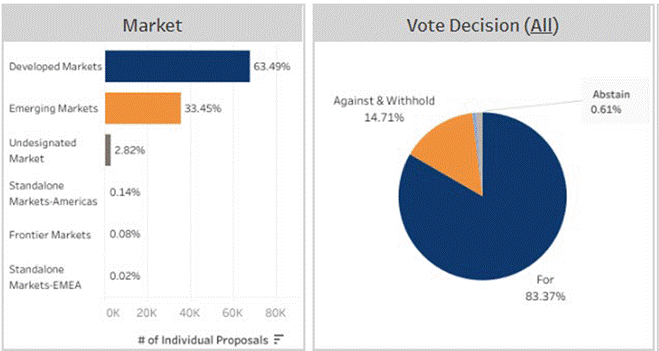
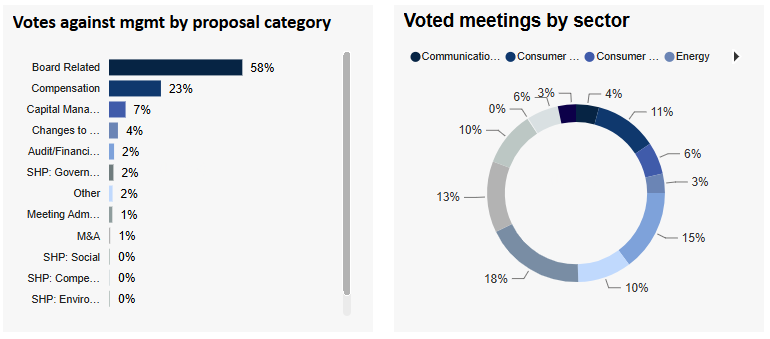
For the full fiscal year ending June 30, 2026, SBA staff managed proxy voting across 10,866 meetings worldwide, voting on ballot items including director elections, audit firm ratification, executive compensation plans, mergers & acquisitions, and a variety of other management and shareowner proposals. These votes, which represent a 6.8% decrease from FY2025 levels, involved 8,408 companies with 103,851 distinct voting items—voting 84.1% “For’’ and 13.6% “Against or Withheld,” with the remaining 2.3% involving abstentions. Of all votes cast, 13.8% were “Against” the management-recommended vote, and 58.2% of all global ballots associated with at least one negative vote cast. In FY2026, SBA proxy voting occurred in 69 countries, with the top five by meeting volume comprised of the United States (2,956), India (1,455), China (1,214), Japan (1,146), and Hong Kong (529).
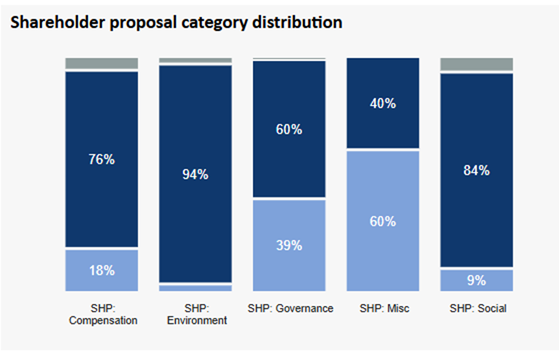
The 2026 U.S. proxy season was marked by continued investor support for management-backed items, with director elections and say-on-pay proposals receiving strong approval rates overall, while executive compensation remained the most prominent source of shareowner dissent. Investors generally reserved opposition for perceived pay-for-performance misalignment, one-time executive awards, over-boarded directors, and governance concerns, resulting in only a limited number of failed say-on-pay votes and director election defeats. A notable takeaway was the continued decline in support for most shareowner proposals, including many environmental and social proposals, alongside a growing tendency for large institutional investors to rely on their own stewardship frameworks rather than external proxy advisor recommendations. This contributed to a more fragmented voting landscape in which outcomes were driven increasingly by company-specific facts, disclosure quality, and demonstrated responsiveness to investors rather than adherence to proxy advisor policies alone.

|
|